Why Your Smooth Makeup Base Crumbles: The Critical Prep Step Acne-Prone Skin Needs
Your foundation can look beautifully smooth when it first touches your skin, then separate around your nose, cling to blemishes, and form tiny flakes across your cheeks before lunchtime. If this sounds familiar, the problem may not be your foundation at all. The missing link in effective acne-prone skin makeup prep is often the way skincare layers settle, absorb, and interact before makeup application.
Acne-prone skin presents a particular challenge: it may feel oily in one area, dehydrated in another, and sensitive to products that promise a perfectly matte finish. Applying more powder, adding another primer, or scrubbing away every trace of texture can make the situation worse. The goal is not to force your skin into a completely poreless state. It is to create a comfortable, balanced surface that allows makeup to spread evenly without emphasizing bumps, flakes, or excess shine.
At a glance: the prep principle that changes everything
- Cleanse gently without leaving your skin tight or stripped.
- Apply a lightweight moisturizer that supports hydration without feeling excessively greasy.
- Give skincare time to settle before introducing primer or foundation.
- Use primer selectively, concentrating on areas where makeup actually slips or emphasizes pores.
- Build coverage with thin layers instead of trying to conceal every irregularity at once.
The most important adjustment is to create a stable, comfortable skincare base before adding makeup—not to accumulate more products.
Why a Smooth Makeup Base Starts Before Primer
Primer is often treated as the essential first step toward flawless velvet skin. However, primer cannot reliably correct a skincare layer that is too heavy, a complexion that is visibly flaky, or a moisturizer that has not settled. When several products remain slippery on the surface, foundation may move instead of adhering evenly.
Think of your makeup base as a sequence of layers. Clean skin provides the starting point, moisturizer helps maintain comfort and hydration, sunscreen provides daytime protection, and primer can modify the surface for makeup. Foundation comes last. Each layer needs to work with the others rather than compete with them.
For example, a rich cream followed immediately by a silicone-rich primer and a full-coverage foundation may feel smooth during application. Yet the combination can become patchy when the foundation is repeatedly rubbed across the surface. In a different situation, a mattifying cleanser and several oil-control products may leave the skin feeling tight, making dry patches more noticeable once pigment settles on them.
These problems have different causes, so they should not receive the same solution. If makeup slips, examine excess surface product and application technique. If it clings to rough areas, investigate dryness, irritation, or dehydration. If it gathers around inflamed blemishes, reduce rubbing and use lighter layers.
The Overlooked Step: Let Skincare Settle Before Makeup
One of the easiest adjustments to test is allowing skincare to settle between application stages. This is not a universal rule that every product must remain untouched for a specific number of minutes. Formulas differ, skin conditions change, and some products are designed to layer readily. The practical objective is to avoid applying the next product while the previous layer still feels excessively wet, slippery, or prone to rolling.
After cleansing, apply moisturizer in a thin, even layer. Give it time to spread and settle, then apply sunscreen if it is part of your daytime routine. Follow the sunscreen's directions and allow it to form an even layer before applying makeup. If the surface still feels unusually slick, reduce the amount of skincare used rather than automatically adding more powder.
The distinction matters because layering problems are not always evidence that a product is unsuitable. Sometimes the formula is compatible, but the quantity is excessive. Sometimes the moisturizer is appropriate for nighttime but feels too rich beneath foundation during the day. Sometimes a sunscreen and primer simply do not cooperate well with the chosen foundation.
Try changing one variable at a time. If your base pills, keep your cleanser and sunscreen consistent while reducing the moisturizer amount or removing primer from the test routine. If the problem persists, swap only the suspected product. This makes it easier to identify the source of the conflict instead of replacing your entire routine without a clear reason.
Choose Hydration Before Chasing an Oil-Free Finish
Acne-prone skin is not automatically the same as oily skin, and oily skin can still experience surface dehydration. A shiny forehead does not necessarily mean that every area of the face needs a stronger mattifying product. Likewise, dry flakes around an active blemish do not mean that the whole complexion needs a heavy cream.
The useful distinction is between how your skin feels and how it looks. Shine describes the appearance of surface oil. Tightness, discomfort, and flaking can indicate that the skin barrier is not tolerating the current routine well. These conditions may occur together, particularly when cleansing is aggressive or multiple potentially irritating treatments are layered.
For daytime makeup, a lightweight lotion or gel-cream may be a practical starting point if your skin becomes shiny quickly. If your cheeks feel tight or foundation repeatedly catches on dry areas, a more cushioning moisturizer may be appropriate. The right texture is the one that leaves your skin comfortable and allows subsequent products to apply evenly.
Look for a formula that suits your skin's tolerance rather than relying on a single ingredient as a guarantee. Glycerin and hyaluronic acid can help attract water, while ingredients such as ceramides can support the skin barrier. Neither an ingredient list nor a product labeled noncomedogenic guarantees that a particular formula will prevent breakouts for every individual.
For a makeup-focused routine, affordable skincare essentials can be more useful than an elaborate collection of trendy treatments. If you browse skincare selections on retailers such as iHerb, evaluate the full formula, intended use, texture, and fragrance content rather than assuming that a premium-looking package will perform better beneath foundation. The objective is compatibility and comfort, not the largest number of active ingredients.
Quick Decision Guide: Match the Fix to the Makeup Problem
Before buying another product, identify the pattern your foundation creates. Different failure points call for different adjustments, and a simple change in application may outperform an additional skincare step.
Use this guide as a troubleshooting tool, not a diagnosis. Several causes can overlap, and a foundation formula may simply be unsuitable for your skin's texture or preferred level of coverage.
Build a Makeup-Compatible Routine in the Right Order
A reliable routine does not need to be complicated. For many acne-prone complexions, the best starting point is a gentle cleanser, a suitable moisturizer, daytime sunscreen, and a carefully chosen makeup product. Primer is optional rather than mandatory.
Step 1: Cleanse without stripping
Remove overnight oil and residue with a cleanser that leaves the skin comfortable. In the morning, a gentle rinse may be sufficient for some people, while others prefer a mild cleanser. Choose according to your skin's needs and existing treatment routine. A squeaky-clean feeling is not a requirement for good makeup adhesion.
Step 2: Apply a measured amount of moisturizer
Spread moisturizer evenly without repeatedly layering it over the same areas. Pay attention to the cheeks, corners of the nose, and areas where active blemishes or treatments may contribute to dryness. If your T-zone becomes slippery, avoid compensating by leaving the rest of your face under-moisturized.
Step 3: Apply sunscreen consistently
For daytime wear, use broad-spectrum sunscreen with SPF 30 or higher, following the product's application instructions. Apply enough to provide the labeled protection and allow the film to settle before makeup. Do not under-apply sunscreen merely to prevent pilling. If the combination consistently rolls up, test a different compatible moisturizer or makeup pairing while preserving adequate sun protection.
Step 4: Decide whether primer is necessary
If foundation already applies evenly, you may not need primer. If pores look more noticeable around the nose, a small amount of smoothing primer can help create a more uniform appearance. If the forehead becomes shiny quickly, an oil-control primer may help in that limited area. If dry patches dominate, avoid automatically choosing a highly mattifying formula.
Step 5: Apply foundation with minimal friction
Start with a thin layer and use gentle pressing or tapping motions. A clean makeup sponge or soft brush can distribute product without excessive rubbing when used appropriately. Build coverage only where needed. Heavy foundation cannot physically erase the texture of acne, and adding more pigment may make raised areas more noticeable.
Step 6: Set strategically
Apply a light dusting of powder to areas that become oily or where makeup tends to transfer. Use less over dry patches and raised blemishes. If you need a setting spray, choose one that works with your skin and makeup preferences, and avoid saturating the face with multiple finishing products in an attempt to rescue a poorly prepared base.
Acne-Safe Primer Is About Compatibility, Not a Label Alone
Primer can be useful, but its role is specific. Smoothing primers are designed to soften the visible appearance of pores and uneven texture. Mattifying primers help manage the appearance of shine. Hydrating primers can make a complexion feel more comfortable when used with a compatible skincare routine. These categories overlap, and product performance depends on the complete formula.
For acne-prone skin, a noncomedogenic claim can be a useful starting point, but it is not an absolute guarantee. Individual reactions vary, and a product's marketing language cannot establish that it will never contribute to congestion or irritation. Consider how the formula feels, how it layers, and whether your skin tolerates it over time.
Silicone-containing primers are not inherently unsuitable for acne-prone skin. Their texture can help makeup glide across the surface and soften the look of pores. Similarly, a water-based label does not automatically mean that a primer will work well with every water-based foundation. Ingredients, film-forming agents, application amounts, and the layers underneath all influence performance.
When comparing affordable essentials on iHerb or elsewhere, focus on a few practical questions: Does the product fit your skin's hydration needs? Is the formula comfortable? Does it apply evenly with your sunscreen and foundation? Can you use it without triggering persistent discomfort? These questions are more useful than assuming that an expensive primer will automatically create a better base.
A practical rule is to begin with the fewest products necessary. If moisturizer and sunscreen already create a stable surface, skip primer. If pores remain visually prominent but the skin feels comfortable, test a smoothing primer in a small area. If oil breaks through only on the forehead, use a targeted mattifying product rather than covering the entire face with the strongest available formula.
What to Do Now: A Simple Routine Reset
If your makeup has been crumbling repeatedly, resist the urge to replace everything in your vanity at once. A short, structured reset makes it easier to determine whether the problem comes from product quantity, formula compatibility, or skin condition.
Your smooth-base checklist
- ☐ Cleanse gently and avoid leaving your skin tight.
- ☐ Apply a moisturizer suited to your skin's current comfort level.
- ☐ Apply sunscreen adequately and let the layer settle.
- ☐ Skip primer for the first test if you suspect too many layers.
- ☐ Apply a thin layer of foundation using light pressure.
- ☐ Add concealer only where extra coverage is needed.
- ☐ Powder only the areas that need help with shine or transfer.
- ☐ Observe where makeup fails instead of judging the entire face at once.
For a useful comparison, keep your routine stable for a few applications and change only one variable at a time. First test whether reducing excess product improves pilling. Next, assess whether the moisturizer provides enough comfort without leaving a slippery surface. Only then introduce a primer if there is a clear reason to use one.
If the base improves when primer is removed, investigate whether the primer is incompatible with the other layers or simply unnecessary. If foundation still clings to flakes, examine your skincare tolerance rather than adding more mattifying products. If it separates mainly in oily areas, experiment with targeted oil control and lighter application.
One important limitation: a better makeup routine cannot correct every underlying skin concern. Persistent irritation, painful acne, or ongoing flaking may require a change in skincare treatment rather than another cosmetic product. Makeup techniques are useful for appearance and wear, but they should not replace appropriate care for skin conditions.
Cautions: When More Prep Can Make Things Worse
Important caution for acne-prone skin
Do not aggressively exfoliate, scrub active blemishes, or add several new acne treatments simply because foundation looks textured. Irritation and barrier disruption can increase discomfort and make flakes more visible. Avoid picking at blemishes, and discontinue a cosmetic product that repeatedly causes burning, itching, swelling, or a worsening rash. Seek medical advice for severe or persistent reactions.
Acne treatments can also affect how makeup sits. Ingredients such as benzoyl peroxide, salicylic acid, and topical retinoids may be useful in appropriate acne routines, but they can also contribute to dryness or irritation depending on the product and the individual. Do not increase their frequency or combine additional actives just to create a smoother cosmetic surface.
There is also a trade-off between a perfectly matte finish and a comfortable skin barrier. Strong oil control may reduce visible shine temporarily, but it can be counterproductive if it leaves your skin irritated or flaky. Conversely, a very rich moisturizer may feel comforting but cause makeup to slide if too much is applied beneath a particular foundation.
Choose the result that makes sense for your skin rather than pursuing a completely flat, poreless appearance at any cost. Natural pores, fine lines, and some acne texture are normal. A successful base can look polished while still allowing skin to look like skin.
Frequently Asked Questions
1. Why does my foundation pill even when I use expensive skincare?
Price does not determine compatibility. Pilling can occur when layers roll together because of product quantity, film-forming ingredients, friction, or insufficient settling time. Reduce the number of layers, apply smaller amounts, and press makeup on gently. Test one change at a time before replacing multiple products.
2. Should acne-prone skin always use a mattifying primer?
No. Mattifying primer is most useful when excess shine is a specific concern. If your skin feels tight or has flaky patches, a strongly mattifying formula may emphasize texture. You can use primer only on the forehead, nose, or other areas where it provides a visible benefit.
3. Is silicone primer bad for acne-prone skin?
Not automatically. Silicone-based formulas can help makeup glide and soften the appearance of pores. Acne suitability depends on the overall formulation, individual tolerance, and how the product fits into the rest of the routine. A product label alone cannot guarantee that a formula will work for everyone.
4. How long should I wait between moisturizer and foundation?
There is no universal waiting time for every formula. Allow moisturizer and sunscreen to settle until the surface no longer feels excessively wet or slippery, while following the sunscreen's instructions. If pilling continues, changing the amount or product combination may help more than waiting longer.
5. Can I skip moisturizer if my face becomes oily quickly?
Oily skin can still benefit from suitable hydration. Skipping moisturizer may be uncomfortable, particularly if your routine includes potentially drying acne treatments. Try a lighter lotion or gel-cream and adjust the amount to your skin's needs rather than assuming that all moisture must be eliminated.
6. Why does makeup cling to pimples and acne scars?
Raised blemishes, uneven texture, and dry surrounding skin can change how pigment settles. Applying thicker foundation may emphasize these differences. Use a thin overall layer, blend gently, and add small amounts of concealer only where more coverage is necessary. Makeup can soften the appearance of texture but cannot remove it.
7. Should I exfoliate before every makeup application?
No. Frequent exfoliation is not a requirement for smooth foundation, and excessive exfoliation may increase irritation or flaking. Follow the needs of your skin and any treatment instructions you have been given. If persistent roughness is accompanied by redness, burning, or discomfort, reassess your routine instead of exfoliating more aggressively.
8. What is the first product I should change if my base keeps crumbling?
Start with the layer most closely associated with the problem. If the product visibly rolls before foundation is applied, investigate skincare quantity and layering. If the base becomes flaky, reconsider hydration and irritation. If it separates mainly in oily areas, test targeted oil control. There is no single product that fixes every cause.
The Real Secret to Flawless Velvet Skin
A smooth makeup base for acne-prone skin is less about finding a miraculous primer and more about creating the right conditions for every layer to work. Gentle cleansing, appropriate hydration, consistent sunscreen use, sensible application amounts, and a compatible foundation form the foundation of a reliable routine. Primer becomes useful when it addresses a specific problem rather than serving as an automatic extra step.
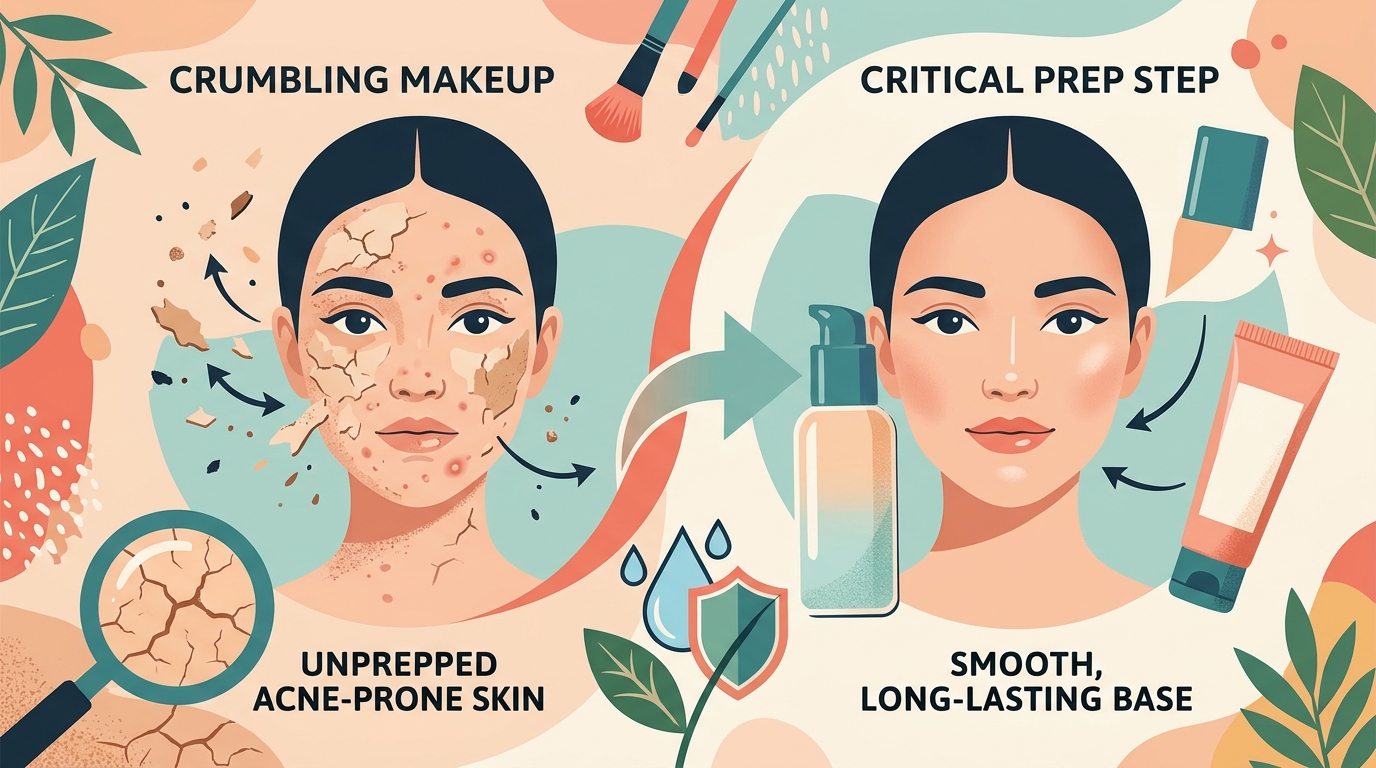
The critical prep step is giving your skincare a chance to settle while keeping the overall routine balanced. When foundation crumbles, look for the actual failure point: slippery layers, insufficient comfort, excess powder, repeated rubbing, or texture that coverage cannot completely disguise. Then make the smallest change likely to solve it.
Premium-looking results do not require an overloaded routine or an expensive product at every stage. A well-matched moisturizer, a sunscreen that layers comfortably, and an optional pore-blurring tool can be enough to improve the appearance of your base. Whether you explore affordable skincare essentials on iHerb or use products you already own, prioritize formula compatibility and skin tolerance over marketing promises.
The most convincing flawless velvet skin is not skin with no visible pores. It is skin that feels comfortable, looks naturally polished, and wears makeup without unnecessary layers fighting one another. Start with the preparation, identify the real problem, and let every additional product earn its place in your routine.


Comments
Post a Comment