The #1 Pre-Makeup Mistake Sabotaging Your Velvet Skin Base on Acne-Prone Skin
Achieving a flawless velvet skin base on acne-prone skin is not simply about finding the right foundation or investing in an expensive pore-blurring primer. The real difference often begins before makeup touches your face. Effective Skincare prep for acne-prone skin requires a careful balance of hydration, gentle cleansing, and product layering. Get that balance wrong, and even premium complexion products can emphasize pores, cling to dry patches, and separate around active blemishes.
There is one particularly damaging pre-makeup habit: over-cleansing and stripping the skin in an attempt to create an oil-free, perfectly matte canvas. It sounds logical, especially when breakouts and excess shine are regular concerns. However, removing too much of the skin's natural protective lipids can leave the surface uncomfortable, dehydrated, and less receptive to makeup.
The solution is not to add more products or scrub away every trace of oil. It is to prepare the skin so that makeup can sit evenly without compromising its comfort. Here is how to recognize the mistake, correct your routine, and build a smoother, longer-lasting velvet finish.
THE VELVET SKIN QUICK GUIDE
- The biggest mistake: Over-cleansing and stripping acne-prone skin to eliminate all surface oil.
- Why it matters: Dehydrated, irritated skin can develop visible flakes, uneven texture, and makeup application difficulties.
- The priority: Gentle cleansing, lightweight hydration, and a non-comedogenic moisturizer.
- The makeup step: Use a thin layer of pore-blurring primer only where texture or visible pores need additional smoothing.
- The goal: A comfortable, balanced surface that supports a natural-looking, soft-focus makeup finish.
1. The #1 Mistake: Stripping Acne-Prone Skin Before Makeup
When your skin produces excess sebum, the instinct to remove every trace of oil before applying makeup can be difficult to resist. A squeaky-clean feeling may seem like proof that your skincare routine has worked. Unfortunately, that sensation is not a reliable indicator of healthy skin preparation.
Your skin has a natural protective barrier that helps retain moisture and defend against external irritants. Cleansing too aggressively, using excessively hot water, or repeatedly washing the face can disrupt this barrier. Strong cleansing products may also remove some of the lipids that contribute to the skin's protective surface.
What happens next can complicate your makeup routine.
- Visible dehydration: Skin can appear dull, tight, or less supple after cleansing.
- Uneven texture: Dry surface areas may become more noticeable beneath complexion products.
- Increased discomfort: Skin that already feels sensitive may react more easily to additional skincare and makeup layers.
- Inconsistent shine: Some areas may feel dry while other areas continue producing visible oil.
- Less comfortable makeup wear: Foundation may emphasize flaky areas or settle unevenly around blemishes.
It is important to understand that oily skin and dehydrated skin are not mutually exclusive. Your complexion can produce plenty of sebum while still lacking sufficient water in its outer layers.
This is why an aggressively matte preparation routine is not necessarily the best approach for acne-prone skin. The objective should be a balanced surface, not the complete elimination of natural oil.
2. Why Dehydrated Skin Can Ruin a Velvet Makeup Finish
A velvet complexion has a distinctive appearance. It combines the visual softness of a matte finish with enough natural dimension to avoid looking flat, powdery, or excessively dry.
To achieve that effect, the skin's surface needs to be reasonably smooth and comfortable before makeup application. Hydration helps support the appearance of suppleness, while an appropriate moisturizer reduces the likelihood of a visibly dry surface.
Consider what happens when foundation is applied to skin that feels tight after cleansing. Instead of creating an even-looking layer, complexion products may highlight small irregularities that would otherwise be less noticeable.
These issues can become particularly apparent around the nose, chin, forehead, and areas with previous blemish marks.
There is also an important distinction between pores and dehydration. Pores are normal anatomical structures, and their appearance is influenced by factors such as genetics, oil production, and skin structure. Skincare and makeup cannot permanently erase them.
However, a well-hydrated surface and strategically applied primer can temporarily improve the appearance of uneven texture and visible pores.
The practical takeaway: If your foundation repeatedly clings to dry patches despite using a good formula, examine your cleansing and moisturizing steps before purchasing another foundation. The problem may be the condition of the skin underneath your makeup.
3. The Correct Skincare Prep for Acne-Prone Skin: Four Essential Steps
A complicated morning routine is not automatically more effective. For acne-prone skin, a shorter routine with compatible products can make it easier to identify irritation, avoid unnecessary layering, and prepare the complexion consistently.
Step 1: Choose a Gentle Cleanser
Begin with a gentle cleanser formulated for your skin type. The goal is to remove overnight skincare residue, excess surface oil, and impurities without leaving your face feeling stripped.
Look for a formula that cleanses effectively without an unnecessarily harsh fragrance or an aggressive combination of cleansing ingredients. A gentle cleanser for acne-prone skin should leave your complexion feeling comfortable rather than unusually tight.
Use lukewarm water and your fingertips. Avoid vigorous rubbing, rough cleansing brushes, and abrasive scrubs, particularly when active breakouts or irritation are present.
Fast decision: If your face feels tight immediately after cleansing, consider switching to a gentler formula or reducing unnecessary cleansing frequency. If your skin already feels comfortable, there is no reason to replace a cleanser that works well.
Step 2: Add a Lightweight Hydrating Serum
After cleansing, a hydrating serum for sensitive skin can provide an additional layer of moisture without necessarily creating a heavy or greasy finish.
Ingredients such as glycerin and hyaluronic acid are commonly used as humectants. They help attract and retain water within the skin's outer layers when used as part of an appropriate skincare routine.
These ingredients can be useful when your complexion feels tight or looks temporarily dehydrated. However, more serum does not mean better hydration. Applying several overlapping layers may leave unnecessary residue beneath foundation.
Apply a small amount according to the product instructions. Allow it to settle before moving to moisturizer.
If your skin is highly reactive, introduce new products individually rather than combining several unfamiliar formulas on the same morning.
Step 3: Seal in Comfort With a Non-Comedogenic Moisturizer
This is the step that people with oily or acne-prone skin sometimes skip. They worry that moisturizer will make their complexion shiny or encourage more breakouts.
However, avoiding moisturizer entirely can leave the skin feeling uncomfortable, particularly after cleansing or when using products that can cause dryness.
A lightweight, non-comedogenic moisturizer can help support the skin barrier while providing a more comfortable surface for makeup application.
Non-comedogenic generally means that a product is formulated or assessed with the intention of reducing pore-clogging potential. It is not an absolute guarantee that every person will tolerate the formula.
Look for a texture that suits your skin. A lightweight lotion or gel-cream may be preferable to a rich, heavy cream if your T-zone becomes shiny quickly.
Apply an even, modest layer rather than concentrating excessive moisturizer on the areas that already feel oily.
Step 4: Finish With Sunscreen Before Makeup
For daytime makeup, broad-spectrum sunscreen is an essential part of preparation. Choose a sunscreen with SPF 30 or higher that suits your skin and offers comfortable daily wear.
Acne-prone skin does not need to sacrifice sun protection to achieve a soft-focus makeup finish. A lightweight, non-comedogenic sunscreen may be a useful option if heavier formulas feel uncomfortable.
Apply the appropriate amount according to the product directions and allow the layer to settle before applying primer and foundation.
Remember that sunscreen is not simply another optional makeup-prep product. Its primary purpose is protecting the skin against ultraviolet radiation. Do not reduce the recommended amount to make your foundation look smoother.
4. The Key Comparison: Stripped Skin vs. Balanced Skin
Understanding the difference between aggressive preparation and balanced preparation makes it easier to identify which routine deserves your attention.
The distinction is not that balanced skin will never become shiny or that dehydrated skin cannot wear makeup successfully. Rather, a comfortable, well-prepared surface gives complexion products a better starting point.
5. Where Pore-Blurring Primer Fits Into the Routine
Once cleansing, hydration, moisturizer, and sunscreen are complete, it is time to consider primer.
A pore-blurring primer is a makeup product designed to soften the appearance of pores and surface irregularities temporarily. Many formulas use silicone-based ingredients or other film-forming and light-diffusing components to create a smoother-looking surface.
It can be particularly helpful around the nose, inner cheeks, forehead, and other areas where pores or uneven texture are more noticeable.
However, primer should complement your skincare routine rather than compensate for an uncomfortable skin surface.
Apply Primer Strategically, Not Everywhere
One common application mistake is spreading a large amount of primer across the entire face. This can create unnecessary product buildup, especially when several skincare layers are already present.
Instead, use this decision process:
- If your nose and inner cheeks have visible pores: Apply a small amount of smoothing primer to those specific areas.
- If your forehead becomes shiny quickly: Consider a lightweight mattifying primer only where shine is a concern.
- If your cheeks feel dry: Prioritize comfortable skincare rather than adding more mattifying products.
- If your skin already looks smooth: You may not need primer across your entire face.
- If your foundation pills: Review product compatibility, application amounts, and waiting time before adding another layer.
Use gentle pressing or smoothing motions according to the primer's directions. Avoid repeatedly rubbing the product over the same area.
Allow the primer to settle before foundation application. The correct waiting time varies between formulas, so follow the product instructions instead of assuming every primer requires the same interval.
6. The Smart Product Approach: What Your Routine Actually Needs
Creating a flawless velvet skin routine does not require an overflowing skincare shelf. The most useful approach is to prioritize products according to their function and how your skin responds to them.
Affordable skincare essentials available through retailers such as iHerb can make it easier to explore gentle cleansers, hydrating serums, and lightweight moisturizers. The important consideration is the formulation, not the retailer or the packaging.
When examining skincare options, consider these functional categories:
- Gentle cleanser: Prioritize effective cleansing without excessive dryness or irritation.
- Hydrating serum: Consider simple humectant-based formulas if your skin feels dehydrated.
- Non-comedogenic moisturizer: Look for a comfortable texture that supports daily barrier care.
- Daily sunscreen: Choose broad-spectrum protection with an SPF of at least 30.
- Pore-blurring primer: Use this as a finishing makeup tool to improve the appearance of texture.
Do not assume that an expensive product is automatically more effective. A straightforward moisturizer that your skin tolerates consistently may be more useful than a premium formula containing multiple unnecessary extras.
Likewise, a product marketed specifically for acne-prone skin is not guaranteed to work for every complexion. Individual tolerance, ingredient combinations, and application habits all matter.
Core priority: If you can only improve one part of your current morning routine, start by correcting the cleansing step if it leaves your face tight or uncomfortable. If cleansing is already gentle but your foundation emphasizes dry patches, review your moisturizer and hydration instead.
7. What to Do Now: A Practical Velvet Skin Checklist
Use this simple checklist before your next makeup application. It is designed to make the routine easier to follow without adding unnecessary steps.
YOUR PRE-MAKEUP CHECKLIST
- ☐ Cleanse gently with lukewarm water.
- ☐ Avoid harsh scrubbing and excessive cleansing.
- ☐ Apply a lightweight hydrating serum if needed.
- ☐ Use a suitable non-comedogenic moisturizer.
- ☐ Apply broad-spectrum SPF 30 or higher during the day.
- ☐ Allow skincare layers to settle according to product directions.
- ☐ Apply a small amount of pore-blurring primer where necessary.
- ☐ Use thin, even layers of foundation instead of excessive coverage.
- ☐ Blend gently without repeatedly rubbing active blemishes.
- ☐ Check whether the skin feels comfortable before adding powder.
The biggest improvement often comes from removing unnecessary steps rather than introducing more products.
A Simple Morning Timeline
Although individual products have different application requirements, the following sequence provides a useful starting point:
- Cleanse: Remove overnight residue and excess surface oil.
- Hydrate: Apply a lightweight serum when appropriate.
- Moisturize: Support skin comfort with a suitable moisturizer.
- Protect: Apply sunscreen as directed.
- Prime: Smooth selected areas after skincare has settled.
- Apply makeup: Build coverage gradually with thin layers.
If your skin feels comfortable and your makeup sits evenly, there is no need to add extra products simply because they are popular in beauty routines.
8. Caution: More Skincare Is Not Always Better
IMPORTANT SKINCARE CAUTION
Aggressive exfoliation, repeated cleansing, and combining multiple active ingredients immediately before makeup can increase the possibility of irritation. Avoid using harsh scrubs or introducing several new treatments at once to achieve a smoother-looking base.
If your skin is burning, unusually red, peeling, or uncomfortable, prioritize a gentle routine and avoid applying additional potentially irritating products. Persistent or severe acne and irritation may require assessment by a qualified dermatologist.
There is also an important exception to the general recommendation to use lightweight hydration. Some people with acne-prone skin have naturally dry skin, experience seasonal dryness, or use prescribed acne treatments that cause significant dryness. These individuals may need a richer moisturizer than someone with a very oily T-zone.
Do not force yourself into a lightweight gel-only routine simply because it is commonly associated with oily skin. Choose the texture that supports your skin's comfort and tolerance.
Another limitation concerns pore-blurring products. Primers can temporarily soften the appearance of pores, but they cannot permanently shrink pores, remove acne scars, or treat active acne. Makeup techniques are cosmetic solutions, not substitutes for appropriate skincare or professional treatment.
If you use prescription acne medication, follow your clinician's directions. Do not discontinue or change an established treatment solely to improve makeup application.
9. Common Pre-Makeup Habits That Can Work Against You
Even with the correct products, small application habits can interfere with a smooth base. Review these common mistakes before changing your entire skincare collection.
Using Too Much Product
Applying several thick layers of serum, moisturizer, sunscreen, and primer can create a surface that feels sticky or difficult to work with. Product buildup may contribute to pilling, especially when formulas do not layer well together.
Use appropriate amounts, respect sunscreen application requirements, and allow individual layers to settle.
Exfoliating Right Before an Important Makeup Day
Trying a new exfoliating treatment immediately before an event can be a risky strategy, particularly if your skin is sensitive or acne-prone.
Exfoliation is not required every morning to create a smooth-looking makeup base. If you already tolerate an exfoliating product, use it according to its directions and avoid unnecessary overuse.
Applying Foundation Before Skincare Has Settled
Moving too quickly between skincare and makeup can make layering less predictable. Your moisturizer or sunscreen may still feel wet, making primer application more difficult.
Give products time to settle based on their formulas and instructions. If pilling continues, simplify the number of layers or examine whether the products are compatible.
Using Powder to Fix Every Texture Problem
Powder can help manage visible shine, but applying more and more powder will not necessarily make uneven texture disappear.
Excessive powder can make dry areas look more pronounced. Concentrate application on areas that genuinely need shine control and keep the rest of the complexion more flexible.
10. Frequently Asked Questions About Acne-Prone Skin Prep
1. Should I moisturize acne-prone skin before applying makeup?
Yes, generally. Acne-prone skin still benefits from appropriate moisturization. Choose a formula that suits your skin type and does not consistently cause congestion or irritation. A lightweight, non-comedogenic moisturizer can provide a comfortable base for foundation without requiring a heavy layer.
2. Can dehydrated skin still be oily?
Yes. Dehydration refers to insufficient water in the skin's outer layers, whereas oiliness relates to sebum production. These conditions can occur together. This is why removing all surface oil is not an effective universal solution for creating a smooth makeup base.
3. What is the best cleanser for acne-prone skin before makeup?
There is no single cleanser that works for everyone. A gentle cleanser that removes impurities without leaving the skin tight or irritated is a sensible starting point. If you use an acne treatment cleanser, follow its instructions and consider your skin's overall tolerance.
4. Do I really need a hydrating serum before foundation?
No. A hydrating serum is an optional step rather than a universal requirement. It may be useful if your skin feels dehydrated or if your existing moisturizer does not provide enough comfort. If your moisturizer already works well and your foundation applies evenly, an additional serum may be unnecessary.
5. Does pore-blurring primer clog pores?
Not necessarily. Pore-blurring primers use different formulations, and their effects depend on the ingredients and individual skin tolerance. Look for a product suitable for your complexion, remove makeup thoroughly at the end of the day, and discontinue a product if you notice persistent irritation or worsening congestion.
6. Why does my foundation look patchy even after moisturizing?
Several factors can contribute to patchy foundation, including residual dryness, incompatible product layers, excessive primer, insufficient settling time, or a foundation formula that does not suit your skin. Examine the routine one step at a time rather than adding several products simultaneously.
7. Should oily acne-prone skin use a matte primer?
It can, particularly if excess shine is concentrated around the forehead, nose, and chin. However, a matte primer is not necessary across the entire face. If your cheeks are dry or sensitive, using a smoothing product only in the oily areas may create a more balanced result.
8. Can good skincare prep make pores disappear?
No. Pores are a normal feature of skin and cannot be permanently erased through skincare or makeup. However, hydration, suitable moisturization, and a well-formulated pore-blurring primer can temporarily improve the appearance of uneven texture and visible pores.
9. How long should I wait between skincare and makeup?
There is no universal waiting time for every formula. Allow each layer to settle until the surface feels comfortable and is no longer excessively wet or slippery. Follow sunscreen and primer instructions, and adjust the routine if pilling occurs.
10. Can I skip primer if my skincare routine is already effective?
Absolutely. Primer is an optional cosmetic step. If your skin feels comfortable and your foundation already applies smoothly, you may not need one. A good skincare routine should support the skin rather than create dependence on additional makeup products.
11. The Final Velvet Skin Strategy: Balance Before Blurring
The secret to a smooth, long-lasting velvet makeup base on acne-prone skin is not the complete removal of natural oil. It is understanding that a comfortable skin surface provides a better foundation for makeup than one that has been aggressively cleansed and stripped.
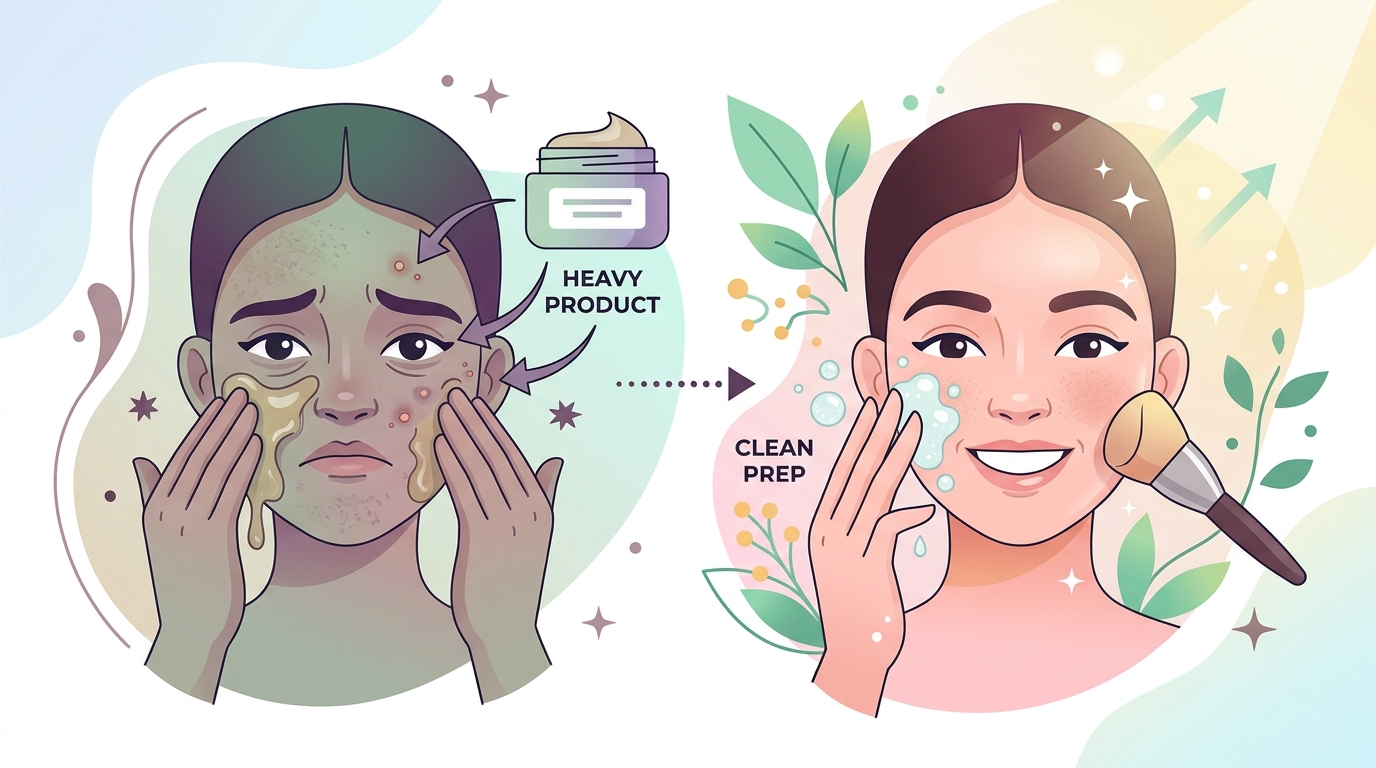
That single change can influence every step that follows. Gentle cleansing helps avoid unnecessary disruption. A hydrating serum can address the appearance of dehydration when needed. A suitable non-comedogenic moisturizer supports daily skin comfort, while sunscreen provides essential daytime protection.
Only after these basics are addressed should pore-blurring primer enter the routine. Applied strategically, it can soften the appearance of pores and help create the refined, soft-focus effect associated with flawless velvet skin.
Remember the priority order: cleanse gently, hydrate appropriately, moisturize consistently, protect with sunscreen, and blur selectively. If your foundation looks patchy, investigate the preparation underneath it before replacing your makeup. If your skin already feels balanced, resist the temptation to add unnecessary layers.
Premium-looking makeup does not require an unnecessarily complicated routine. A few carefully chosen skincare essentials, including a gentle cleanser for acne-prone skin, a suitable hydrating serum, and a lightweight moisturizer, can provide a practical starting point. Affordable options from retailers such as iHerb may also help you explore these everyday skincare categories without making luxury packaging the priority.
Your velvet skin goal should never be a completely poreless or unnaturally matte face. It should be a healthy-looking, comfortable complexion with a smooth visual finish, natural dimension, and makeup that works with your skin rather than against it.
Make the skin comfortable first. Let the makeup do the finishing.


Comments
Post a Comment